Our country is one of the leading countries in rice export to the world market with many delicious rice varieties, favored by consumers. To produce delicious rice, setting quality standards for export is a long process with many stages. In the article below, readers should join Anpha Mechanics to learn specifically about the rice production process including which steps and the role of each step.
What is clean rice?
Clean rice is rice that is grown, fertilized, harvested and produced in a closed process. From the initial stages to the final finished product, no toxic chemicals are used. Clean rice is completely natural in origin, safe for the health of users.
Some delicious Vietnamese rice varieties that are favored by consumers
Vietnam has many rice varieties that are produced on a large scale, including many delicious rice varieties that are highly appreciated by consumers when introduced to the market. Some of the most outstanding delicious rice varieties include:
- Lai fragrant rice
- Thai fragrant rice
- ST25 rice
- ST24 rice
- Jasmine fragrant rice 85
- Tai Nguyen rice
- Lai Mien fragrant rice
- Nang Xuan rice
- Bac Huong rice
- Tam Xoan rice
- Ham Chau rice
- Mai Vang milk rice,…
Learn more about the current clean rice production process
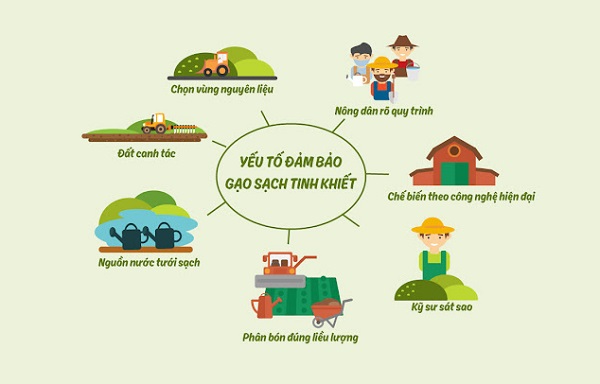
Below is the detailed clean rice production process step by step from the stage of selecting seeds for planting to harvesting, processing and packaging.
Selecting and sowing seeds
Select the type of rice you want to grow, then incubate the rice to germinate and sow it in the field. Rice seeds should be selected for good yield, easy care, and less susceptible to pests and diseases to make the care process easier.
Rice care
In the process of caring for clean rice, do not use any chemical fertilizers or pesticides. Everything is done manually, using organic fertilizers.
Harvesting
When the rice is golden and ripe, harvest it. The harvested rice seeds need to be dried immediately to avoid germination. Once the rice is dry, it will be brought to the factory to carry out the next steps.
Cleaning and classifying raw materials
Rice produced by themselves or purchased from farmers will be gathered and brought to the factory. Here, impurities, sand, stems, and leaves left over from farmers’ harvesting and drying will be cleaned to ensure the best quality when packaged. After cleaning, the raw materials will be classified.
The commonly used methods for cleaning and classifying raw materials for rice production today include:
- Method of cleaning and classifying raw materials by size
- Method of cleaning and classifying raw materials by aerodynamic properties.
- Method of cleaning and classifying raw materials by specific gravity.
- Method of cleaning and classifying raw materials based on the surface of raw materials.
- Method of cleaning and classifying raw materials based on color of raw materials.
- Method of cleaning and classifying raw materials based on magnetism.
Drying
Rice purchased from people has been dried, however, to ensure the quality of rice grains can be preserved for the longest time, rice factories often re-dry the raw materials until they reach the standard dryness.
Removing the hull (milling)
After drying, the raw materials will be brought to the next stage for milling, removing the outer husk, keeping only the white rice kernel.
During the milling process, the milling force will be adjusted so that the milled rice grains will retain a thin bran layer on the outside and minimize the impact on this bran layer because this layer contains many nutrients and vitamins that are beneficial for health.
Rice polishing
To make the milled rice more shiny, beautiful, and attractive to consumers when brought to the market, after milling, the rice will be polished. Most types of rice distributed on the market today are polished before being packaged.
Checking the quality of rice
After milling and polishing, the next step is to control the quality of the finished rice. All milled rice is led through a strict inspection and control system. This process will help remove all the sand particles mixed in the rice, ensuring that the rice used by customers does not have any problems.
Packing into packaging
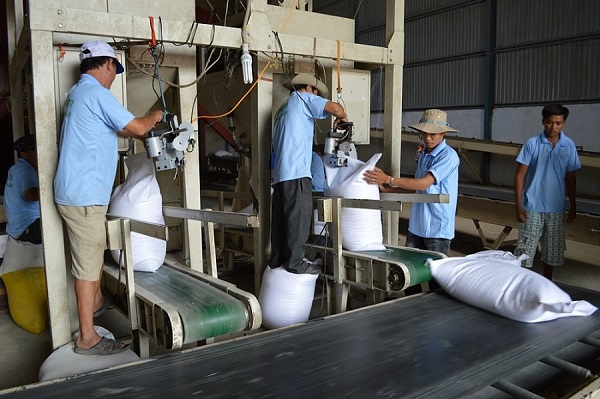
After checking and the rice meets the required quality standards, the rice and packaging will be carried out for preservation and transportation to consumption. Rice will be packed into bags using specialized rice packing machines with various quantities from 1kg, 5kg, 10kg, 20kg, etc. to meet the diverse needs of the market.